ThinkingVLA: Interleaved Vision and Language Reasoning for Robotic Manipulation

Tianyi Lu1,2, Hui Zhang1, Zijie Diao1, Junke Wang1, Shengqi Xu1, Xingyao Lin1,2, Guojin Zhong1, Ziyi Ye1, Peng Wang4, Zuxuan Wu1,2,3, Yu-Gang Jiang1
1Fudan University, 2Shanghai Innovation Institute, 3Neote AI, 4China Unicom
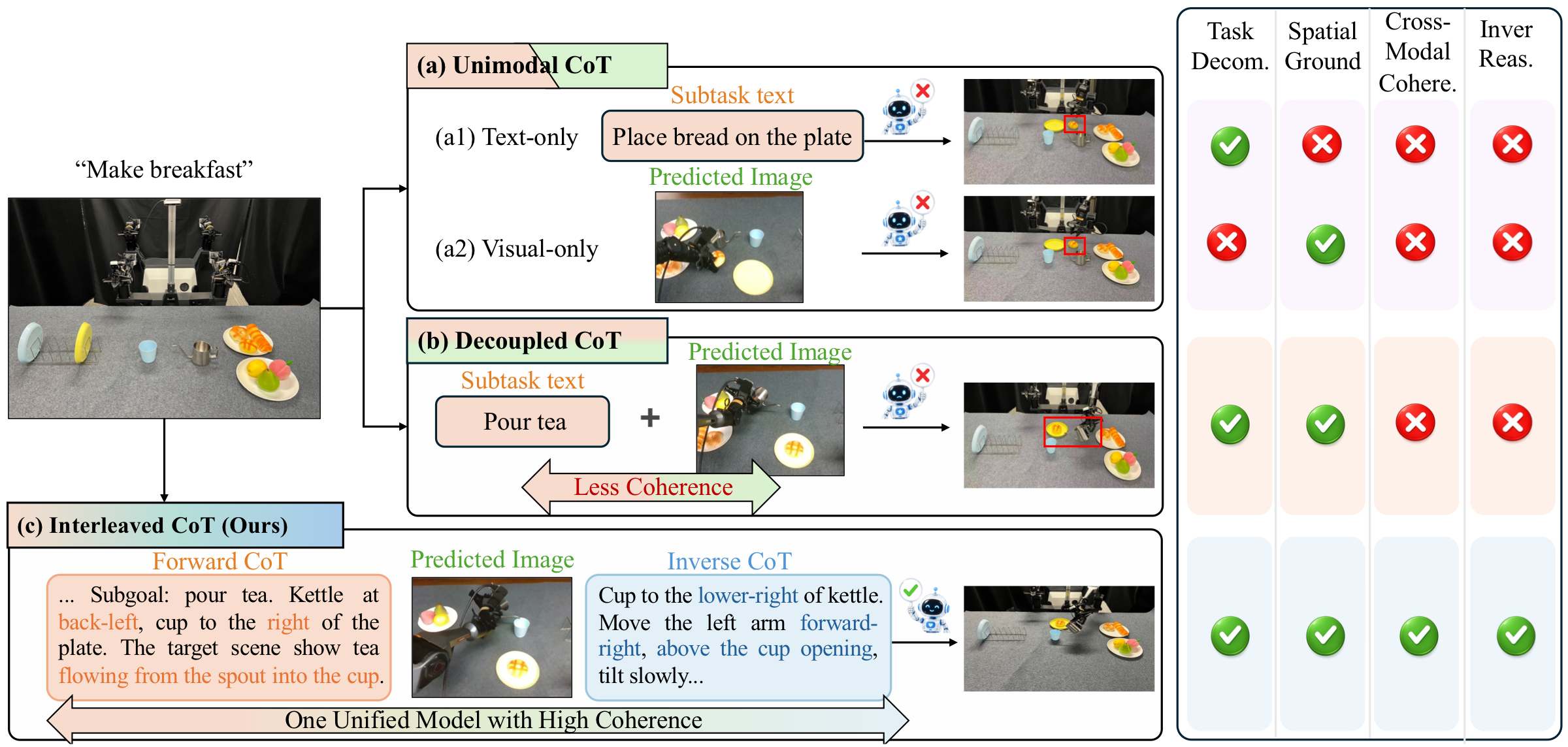
ThinkingVLA teaser figure

ThinkingVLA decomposes manipulation planning into prediction and inverse dynamics, bridged by interleaved textual and visual chain-of-thought reasoning within a unified autoregressive architecture.

Abstract

Most Vision-Language-Action (VLA) models map observations directly to actions without explicit reasoning, limiting their capacity for reasoning-intensive long-horizon tasks. To address this, existing approaches adopt Chain-of-Thought (CoT) reasoning to enable subgoal decomposition and spatial anticipation. However, those methods lack a unified architecture for effective cross-modal reasoning and fail to explicitly include inverse reasoning ability based on the target state.

We argue that manipulation planning naturally decomposes into prediction, anticipating the next visual state, and inverse dynamics, inferring the actions to reach it. Bridging both requires a unified autoregressive architecture that interleaves textual and visual reasoning in a single generation process.

We propose ThinkingVLA, a generative model that realizes this decomposition within a unified Mixture-of-Transformers architecture. ThinkingVLA consists of a forward CoT that identifies the immediate subgoal and guides the visual forecasting; the predicted image then serves as the target state, grounding an inverse CoT that reasons about spatial relationships and action intent based on the predicted image; and the final action is generated conditioned on this full reasoning context. Extensive experiments on simulation and real-world benchmarks demonstrate that ThinkingVLA consistently outperforms state-of-the-art baselines, with particularly large gains on long-horizon manipulation tasks.
Real-World Demos

Basic Tasks

Hang Cup

Arrange Blocks

Place Cubes

Long-Horizon Tasks

Make Breakfast

Assemble Equation

Method

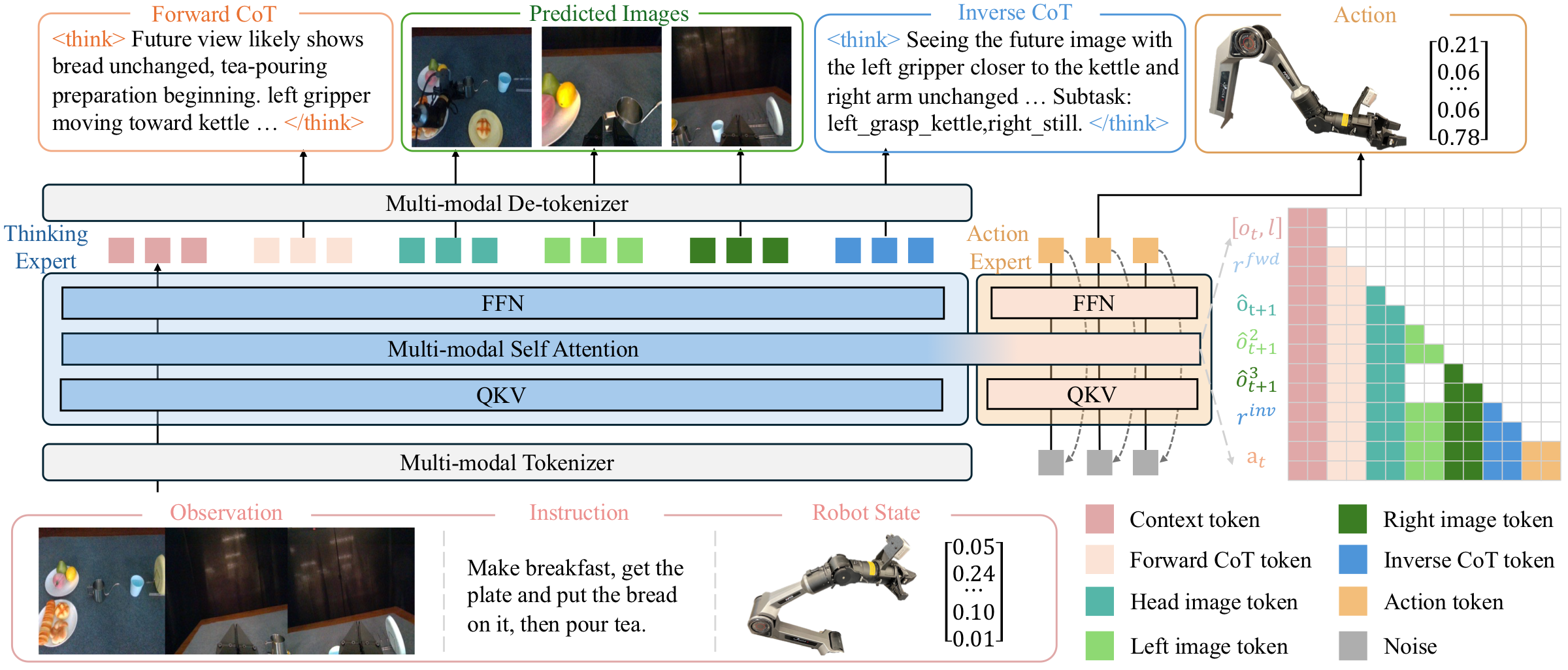
ThinkingVLA adopts a Mixture-of-Transformers (MoT) architecture with two coupled experts: a thinking expert that generates the interleaved reasoning chain, and an action expert that produces action chunks via flow matching.

At each decision step, the model generates a structured reasoning sequence:

  1. Forward CoT: interprets the task instruction and reasons about the desired next state
  2. Future Image Prediction: visualizes the anticipated next state, guided by the forward reasoning
  3. Inverse CoT: reasons about how to reach the predicted state through concrete actions
  4. Action Generation: produces the action chunk conditioned on the full reasoning context
ThinkingVLA architecture

Architecture overview. The thinking expert generates interleaved textual reasoning and future image tokens; the action expert produces the action chunk via flow matching, conditioned on the reasoning context through shared attention.


Training Pipeline

ThinkingVLA is trained in three progressive stages:

  • Stage 1 — Generative Reasoning Pretraining: The thinking expert learns to generate forward reasoning and a single future image, without action prediction.
  • Stage 2 — End-to-end Policy Learning: The action expert is introduced; the model generates the full reasoning chain and predicts actions on a large mixture of manipulation datasets.
  • Stage 3 — Target Robot Adaptation: The full model is fine-tuned on each target dataset, extending to multi-view future image prediction.

Results

Simulation: RoboTwin 2.0

ThinkingVLA achieves the highest average success rate on 20 RoboTwin tasks. The advantage grows with task horizon: on Horizon=3 tasks, ThinkingVLA reaches 60.0% (Easy) and 23.6% (Hard), outperforming all baselines.

Metric π0 XVLA UP-VLA BagelVLA ThinkingVLA (Ours)
EasyHard EasyHard EasyHard EasyHard EasyHard
AvgHorizon=1 61.527.0 85.949.7 76.424.8 91.026.7 90.233.4
AvgHorizon=2 43.66.0 60.223.6 28.83.2 55.87.0 71.026.6
AvgHorizon=3 32.68.6 44.618.6 23.20.2 55.86.8 60.023.6
Avg20 Tasks 49.817.2 69.235.4 51.213.3 73.416.8 77.929.3

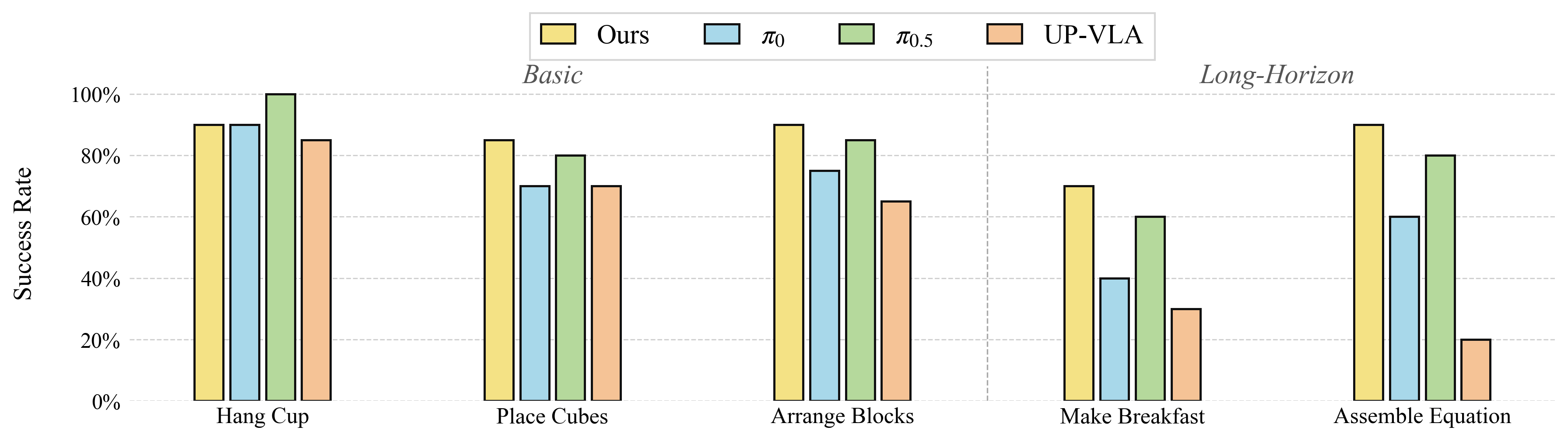
Real-World Results

Real-world results

Real-world results. Success rate (%) over 20 trials per task. ThinkingVLA outperforms baselines especially on long-horizon tasks.

Reasoning Visualization

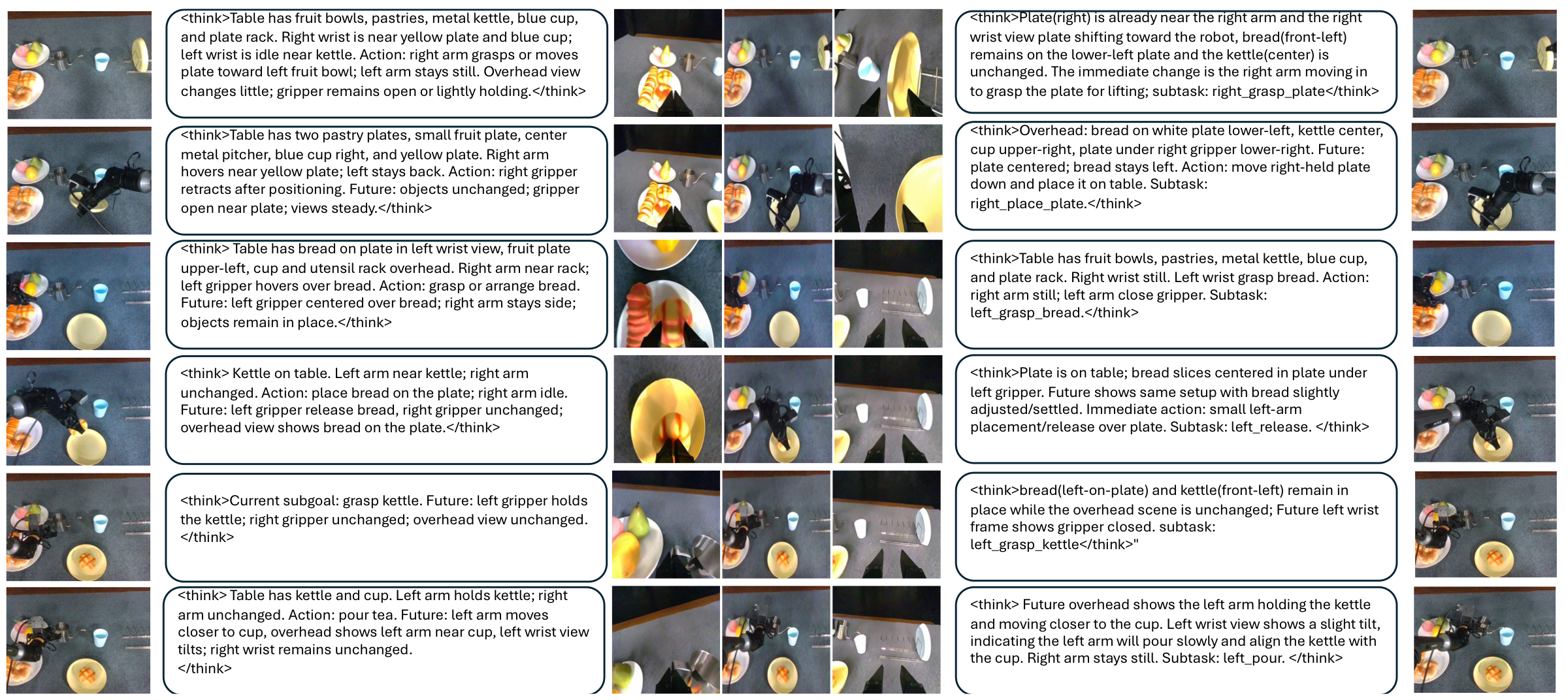
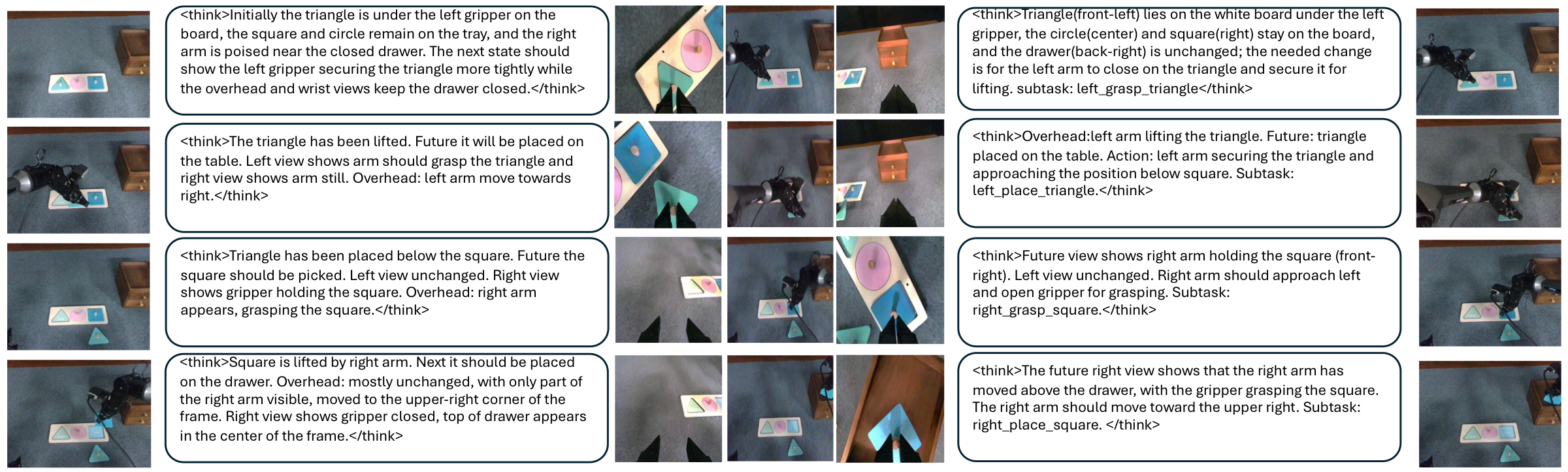
We visualize the complete interleaved reasoning chain produced by ThinkingVLA on real-world rollouts. Each row corresponds to one reasoning step and shows: the current observation, forward CoT reasoning about the expected visual change, predicted multi-view future images, and inverse CoT identifying the action primitive.

Reasoning visualization on Make Breakfast

Interleaved reasoning chain on Make Breakfast (Horizon=3). Six steps cover the full task: grasp plate → place plate → grasp bread → place bread → grasp kettle → pour water. The predicted images closely match the actual observations at the next step.


Reasoning visualization on Place Cubes

Interleaved reasoning chain on Place Cubes (Horizon=2).

BibTeX

@article{lu2026thinkingvla,
  title     = {ThinkingVLA: Interleaved Vision and Language Reasoning for Robotic Manipulation},
  author    = {Lu, Tianyi and Zhang, Hui and Diao, Zijie and Wang, Junke and Xu, Shengqi and Lin, Xingyao and Zhong, Guojin and Ye, Ziyi and Wang, Peng and Wu, Zuxuan and Jiang, Yu-Gang},
  journal   = {arXiv preprint arXiv:2606.17937},
  year      = {2026},
}